Diamond symmetry is one of those specifications that appears on almost every grading report but is often misunderstood by buyers.
You might see two diamonds with almost identical carat, color, clarity, and cut grades, only to notice that one has Excellent symmetry and the other Very Good symmetry.
Should you care?
In most cases, yes, but probably not as much as you should care about overall cut quality.
Symmetry describes how accurately a diamond has been fashioned: whether corresponding facets have been positioned evenly, whether the table and culet are properly centered, whether the outline is balanced, and whether the facet structure lines up as intended.
GIA assesses symmetry from Excellent to Poor, with the same five descriptive grades used for polish: Excellent, Very Good, Good, Fair, and Poor.
For most buyers, my recommendation is straightforward:
Aim for Excellent or Very Good symmetry.
I would strongly prefer Excellent when buying a precision-cut round brilliant, but I would not automatically reject an otherwise beautiful diamond simply because its symmetry grade is Very Good.
The bigger mistake would be prioritizing an Excellent symmetry grade while ignoring poor proportions or weak light performance.
In this guide, I will explain exactly what diamond symmetry means, how it is graded, what graders are looking for, how it differs from polish and cut, and how much you should actually care when buying a diamond.
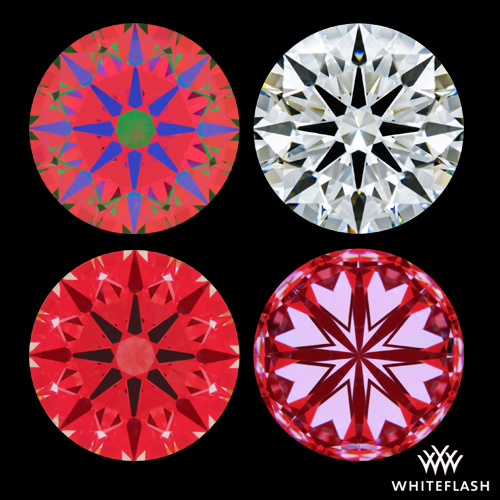
An example of Excellent Diamond Symmetry from Whiteflash
Quick Answer: How Important Is Diamond Symmetry?
If you only want the short version:
| Symmetry Grade | My View |
|---|---|
| Excellent | Ideal, particularly for premium round diamonds |
| Very Good | Excellent choice for most buyers |
| Good | Can be acceptable, but inspect carefully |
| Fair | Usually avoid |
| Poor | Avoid |
For a high-quality round brilliant, I would normally search for Excellent symmetry.
For fancy shapes such as oval, pear, cushion, emerald, and marquise diamonds, Excellent or Very Good symmetry is a sensible target.
But symmetry is only one part of diamond quality.
A diamond with Excellent symmetry can still have mediocre proportions and disappointing light performance.
If you are new to diamond buying, start with my complete guide to the 4Cs of diamonds and my guide to diamond cut quality.
What Is Diamond Symmetry?
Diamond symmetry describes the precision and alignment of a diamond’s shape and facets.
A polished diamond is made up of numerous flat surfaces called facets. On a well-crafted diamond, these facets should be positioned and aligned in a consistent, balanced way.
GIA defines symmetry through characteristics including the exactness of the diamond’s outline and the shape, placement, and alignment of its facets.
Take a standard round brilliant diamond.
When the craftsmanship is highly symmetrical:
- The table should be properly centered
- The outline should be evenly round
- Corresponding facets should be consistent
- Crown and pavilion facets should align correctly
- Facets should meet at the correct positions
- The pavilion should converge neatly toward the center
- The overall facet pattern should look balanced
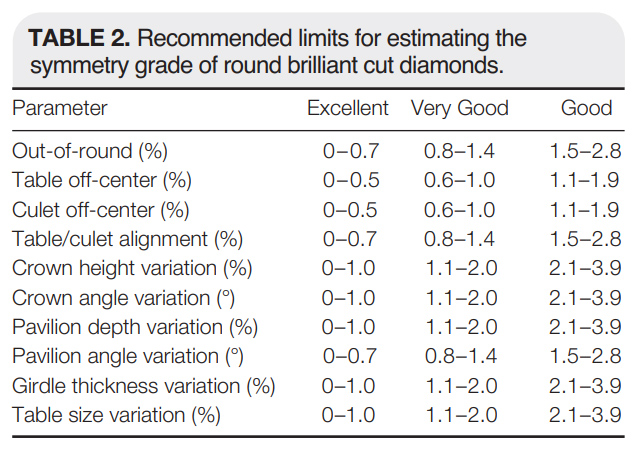
GIA explains that in a diamond with Excellent symmetry, corresponding facets should be consistent in size, shape, and proportion, while the table should be centered and the pavilion facets should meet correctly.
This requires considerable precision from the diamond cutter.
The closer the finished diamond comes to its intended geometric design, the higher its symmetry grade can be.
How Is Diamond Symmetry Graded?
On a GIA grading report, symmetry is graded using five categories:
- Excellent
- Very Good
- Good
- Fair
- Poor
GIA graders assess the exactness of the diamond’s outline and the positioning and alignment of its facets. Symmetry also forms part of GIA’s broader cut-quality assessment for standard round brilliant diamonds.
This is important because the word symmetry can sound like a simple question of whether the left side matches the right.
In reality, graders are examining a three-dimensional object.
They look at the diamond face-up and from other angles, considering multiple possible deviations in its construction.
Excellent Symmetry
Excellent is the highest symmetry grade.
The diamond displays an extremely high level of precision, with no symmetry defects significant enough to materially affect the grade.
Corresponding facets are accurately shaped and positioned, and the diamond’s overall structure is extremely consistent.
For a premium round brilliant, Excellent is what I would ideally look for.
Very Good Symmetry
Very Good indicates minor symmetry deviations.
These are generally small enough that they are unlikely to be obvious to someone looking at the diamond without magnification.
A Very Good symmetry grade should therefore not automatically discourage you from buying an otherwise excellent diamond.
GIA itself notes that Very Good cut diamonds can offer excellent appearance, and minor finishing differences are only one component of overall diamond performance.
My view is that the difference between Excellent and Very Good symmetry is usually not something I would pay a substantial premium for in isolation.
Good Symmetry
Good symmetry indicates more noticeable craftsmanship deviations.
That does not automatically mean the diamond will look bad.
However, once symmetry drops to Good, I would want to inspect the actual diamond more closely and understand why it received that grade.
For a natural diamond where you are spending thousands of dollars, there is normally enough inventory available that I would favor Very Good or Excellent instead.
Fair Symmetry
Fair symmetry indicates more substantial deviations.
At this level, the issues can begin to affect the balance or appearance of the diamond.
Unless there were a very compelling reason to choose the stone, I would normally pass.
Poor Symmetry
Poor symmetry indicates significant craftsmanship problems.
There is rarely a good reason for a modern diamond buyer to accept Poor symmetry when so many better-cut alternatives are available.
I would avoid it.
What Symmetry Problems Do Diamond Graders Look For?
Symmetry grading involves much more than checking whether a diamond looks circular.
Examples of issues that can reduce symmetry include:
- An off-center table
- An off-center culet
- An uneven or wavy girdle
- Unequal crown angles
- Unequal pavilion angles
- Misaligned facets
- Facets that do not meet correctly
- Uneven girdle thickness
- An outline that is not properly balanced
- Variations between corresponding facets
GIA’s grading methodology specifically considers characteristics including facet misalignment, wavy girdles, table positioning, culet positioning, crown-angle variation, pavilion-angle variation, and deviations in the diamond’s outline.
Many of these issues are small.
That is why professional grading takes place under magnification rather than simply by looking at the diamond from normal viewing distance.
Off-Center Table
The table is the large flat facet at the very top of the diamond.
Ideally, it should be centered.
If it is noticeably off-center, the surrounding facets will not be distributed evenly around the stone.
This can disrupt the balance of the facet pattern.
An off-center table is one of the classic examples of a symmetry issue, and GIA notes that even small deviations in table position can disrupt highly ordered optical patterns.
Off-Center Culet
The culet is located at or near the bottom point of the pavilion.
If that point is shifted away from the geometric center of the diamond, the pavilion facets can become uneven.
This can be particularly obvious when viewing a highly symmetrical diamond through specialist imaging.
Fancy shapes also require careful culet placement.
For example, GIA advises that a pear-shaped diamond’s culet should sit appropriately along its line of symmetry, as an off-center culet can negatively affect the appearance of the stone.
Misaligned Facets
A diamond’s facets are designed to follow a deliberate pattern.
When corresponding facets do not line up correctly, the visual pattern can become less ordered.
This is particularly important with precision-cut round brilliant diamonds.
The familiar arrows that can appear through the crown of a highly symmetrical round depend upon extremely accurate facet relationships.
You can see this more clearly in my guide to Hearts and Arrows diamonds.
Uneven Outline
Symmetry also applies to the actual outline of the diamond.
With a round brilliant, you want the stone to look round rather than subtly misshapen.
With fancy shapes, outline symmetry becomes even more obvious.
Consider a pear-shaped diamond.
The two sides should create a balanced outline. One shoulder should not be much higher than the other, and the wings should complement each other.
GIA specifically highlights outline symmetry as particularly important in elongated and asymmetric fancy shapes such as pears, ovals, hearts, and marquises.
Symmetry vs. Cut: They Are Not the Same Thing
This is probably the most important distinction in the article.
Diamond symmetry is not the same thing as diamond cut quality.
Symmetry is one component of craftsmanship.
Cut quality is much broader.
For a standard round brilliant, GIA’s overall cut assessment considers:
- Brightness
- Fire
- Scintillation
- Weight ratio
- Durability
- Polish
- Symmetry
Those factors combine to determine how successful the finished diamond is as a whole.
A diamond could therefore have:
Excellent symmetry
but still have proportions that produce mediocre light performance.
Likewise, a diamond with Very Good symmetry could potentially be more attractive than another diamond with Excellent symmetry if its overall proportions and optical performance are better.
This is why I consistently recommend prioritizing diamond cut over chasing individual grading-report specifications.
Diamond Expert Buying Tip
If you want to compare high-quality diamonds online, I would start with Whiteflash for buyers prioritizing precision cutting and detailed light-performance information, Blue Nile for a much broader inventory to compare, and Brilliant Earth if you are also considering lab-grown diamonds or a wider range of contemporary settings.
You can also read my full Whiteflash review, Blue Nile review, and Brilliant Earth review before choosing a retailer.
Symmetry vs. Polish
Polish and symmetry appear next to each other on many grading reports, which can make buyers assume they measure essentially the same thing.
They do not.
Symmetry
Symmetry considers the positioning, shape, and alignment of the facets and overall diamond.
Polish
Polish assesses the quality and condition of the individual facet surfaces.
A facet can be positioned perfectly but have polishing marks or other surface imperfections.
Likewise, every facet surface might be beautifully polished while the facets themselves are imperfectly aligned.
GIA describes polish as the condition of the facet surfaces and symmetry as the exactness of the outline and arrangement of the facets.
For a high-quality diamond, I generally want both to be:
Excellent or Very Good
with Excellent preferred for premium round brilliants.
What Is a Triple Excellent Diamond?
You may encounter the term:
Triple Excellent
or:
Triple Ex / Triple X
This normally refers to a GIA-graded round brilliant with:
- Excellent Cut
- Excellent Polish
- Excellent Symmetry
GIA confirms that “Triple X” is a trade term used for round brilliant diamonds receiving Excellent grades across all three categories.
It sounds impressive, and it is certainly a useful starting filter.
However, Triple Excellent does not automatically mean exceptional light performance.
GIA’s Excellent cut category contains a range of proportion combinations.
Some Excellent-cut diamonds will therefore handle light more effectively than others.
This is why I recommend going beyond the grading report when shopping for the very best round diamonds.
Read my guide to IdealScope images to understand how reflector imagery can reveal light leakage and optical precision that basic report grades cannot show.
Excellent Symmetry Does Not Mean Perfect Optical Symmetry
This is another important distinction.
A laboratory symmetry grade and optical symmetry are related, but they are not identical concepts.
Grading Report Symmetry
A laboratory such as GIA is evaluating physical craftsmanship:
- Facet alignment
- Outline
- Facet positioning
- Table position
- Culet position
- Other measurable or observable symmetry characteristics
Optical Symmetry
Optical symmetry considers how consistently the facets behave together when interacting with light.
This is where patterns such as Hearts and Arrows become relevant.
A highly precise round brilliant can display eight arrows when viewed from above and eight hearts when viewed through the pavilion using an appropriate viewer.
Those patterns require a level of three-dimensional precision beyond simply receiving an Excellent symmetry grade on a grading report.
GIA’s discussion of modern optical-symmetry analysis similarly demonstrates how very small variations in facet relationships can disrupt highly organized reflection patterns even when the differences are subtle.
Therefore:
Excellent GIA symmetry does not automatically make a diamond Hearts and Arrows.
If you are specifically paying for elite cut precision, I want evidence of that precision.
Read my complete Hearts and Arrows diamond guide for more information.
How Does Symmetry Affect Diamond Sparkle?
This is where symmetry frequently gets overstated.
Symmetry can influence light performance because a diamond’s facets need to work together to direct and reflect light.
Poorly aligned facets can interfere with the intended pattern.
However:
Symmetry alone does not determine sparkle.
You need to consider the entire cut.
A diamond’s proportions, facet angles, light return, contrast pattern, polish, and symmetry all interact.
GIA identifies brightness, fire, and scintillation as key components of face-up cut appearance, while symmetry forms part of the craftsmanship assessment.
This means I would never recommend choosing:
Diamond A: Excellent symmetry but weak proportions
over:
Diamond B: Very Good symmetry but substantially better overall light performance
simply because the first grading report contains the word Excellent one more time.
Look at the complete diamond.
Does Excellent Symmetry Make a Diamond Look Bigger?
Not directly.
The visible size of a diamond is determined much more by:
- Carat weight
- Diameter or dimensions
- Depth
- Shape
- Overall proportions
Symmetry can contribute to a balanced appearance, but an Excellent symmetry grade will not magically make a deep 1 carat diamond look like a 1.20 carat stone.
If visual size matters to you, compare the actual millimeter dimensions alongside carat weight.
You can learn more about this in my diamond carat guide.
Does Diamond Symmetry Affect Price?
Yes, but symmetry is only one component of price.
All else being equal, diamonds with Excellent symmetry can command more than stones with lower symmetry grades, particularly when Excellent symmetry forms part of a premium cut proposition such as a Triple Excellent or precision Hearts and Arrows diamond.
However, you should not evaluate the premium in isolation.
Diamond pricing is also heavily influenced by:
- Carat weight
- Cut quality
- Color
- Clarity
- Shape
- Certification
- Natural vs. lab-grown origin
- Overall desirability
My practical advice is:
Do not pay significantly more solely to move from Very Good symmetry to Excellent unless the diamond is also demonstrably superior in overall cut quality.
For a premium precision-cut round, Excellent symmetry makes sense because it forms part of the overall quality proposition.
For a value-focused purchase, a beautiful Very Good symmetry diamond can sometimes represent a perfectly sensible choice.
How Much Does Symmetry Matter for Round Diamonds?
Round brilliant diamonds are where symmetry becomes most interesting.
A standard round brilliant has a highly ordered facet structure, so craftsmanship precision can contribute to a very balanced pattern.
For a standard high-quality round, I would normally target:
Symmetry: Excellent
That does not mean every Excellent symmetry round is an exceptional diamond.
I still want to assess:
- Crown angle
- Pavilion angle
- Table percentage
- Depth
- Light return
- Contrast
- Optical symmetry
For the very best round diamonds, tools such as ASET, IdealScope, Hearts and Arrows imaging, and other cut-analysis data can provide much more information.
My Diamond Expert guide to the 4Cs explains how these tools can supplement traditional grading information.
How Much Does Symmetry Matter for Fancy-Shaped Diamonds?
Symmetry can actually become more visually obvious with some fancy shapes.
GIA does not currently provide the same standardized overall cut grade for most fancy shapes that it provides for standard round brilliant diamonds, but grading reports can still include polish and symmetry assessments.
This makes symmetry one of the useful pieces of objective information available when assessing shapes such as:
- Oval
- Pear
- Marquise
- Cushion
- Emerald
- Asscher
- Princess
I would generally look for:
Excellent or Very Good symmetry
But you still need to inspect the actual shape.
Oval Diamonds
A good oval should have a balanced outline.
Imagine drawing a line vertically through the center of the stone. The left and right sides should complement each other.
GIA recommends Excellent or Very Good symmetry when evaluating oval diamonds and emphasizes checking whether corresponding sides and facets mirror one another.
You should still assess bow tie, proportions, and facet pattern separately.
Pear Diamonds
Symmetry is especially important in pear-shaped diamonds because an uneven outline can be immediately noticeable.
Look at:
- Shoulders
- Wings
- Point
- Culet position
- Table position
The two sides should feel balanced.
GIA specifically identifies uneven shoulders, wings, tables, and culet positioning as issues that can detract from a pear diamond’s appearance.
Marquise Diamonds
The two pointed ends should line up with one another and the sides should have a balanced curvature.
Even relatively small outline asymmetries can be easier to notice in an elongated stone.
Emerald and Asscher Cuts
Step cuts expose their facet patterns very clearly.
That means symmetry can be particularly important to the crisp, geometric appearance that gives these shapes their character.
For Asscher diamonds, my Asscher cut buying guide recommends focusing on Excellent or Very Good polish and symmetry.
Princess Cuts
GIA does not give standard princess cuts the same overall cut grade used for standard rounds, making polish, symmetry, proportions, and visual assessment particularly important.
Read my complete princess-cut diamond guide for more information.
Should You Ever Buy a Diamond With Good Symmetry?
Possibly.
Good symmetry does not automatically mean an ugly diamond.
If you find a diamond that:
- Looks excellent in video
- Has strong overall proportions
- Offers exceptional value
- Has no visually disturbing symmetry issues
then a Good grade could potentially be considered.
But I would ask a different question:
Why compromise?
The online market gives buyers access to enormous inventories.
In most cases, I would simply continue searching until I found a comparable diamond with Very Good or Excellent symmetry.
The exception might be an unusual fancy shape, antique cut, rare natural diamond, or distinctive stone where the individual appearance matters more than obtaining textbook modern craftsmanship.
Is Very Good Symmetry Enough?
For most buyers:
Yes.
I would have no issue buying a diamond with Very Good symmetry if:
- The overall cut is excellent
- Light performance is strong
- The stone looks balanced
- The price is attractive
- The diamond does not have obvious symmetry issues
Do not become obsessed with obtaining Excellent grades in every single box.
That can lead to overspending without producing a visible improvement.
This is the same principle I use when evaluating diamond color and diamond clarity.
Buy the quality you can appreciate.
Do not simply buy the highest grade available.
When Should You Insist on Excellent Symmetry?
There are circumstances where I would specifically want Excellent.
Premium Round Brilliant Diamonds
If you are paying a premium for the highest possible cut precision, Excellent symmetry should be part of the package.
Hearts and Arrows Diamonds
True Hearts and Arrows diamonds require very high levels of optical precision.
Excellent lab symmetry alone is not sufficient, but I would certainly expect it from a premium precision-cut stone.
High-End Collector Quality
If you are intentionally building a specification sheet with top grades throughout, Excellent is the logical choice.
When the Price Difference Is Minimal
If two genuinely comparable diamonds are close in price and one offers Excellent rather than Very Good symmetry, I would take the Excellent stone.
Where I Would Shop
For buyers specifically prioritizing symmetry, cut precision, and light performance, Whiteflash would be my first stop. Its in-house premium diamonds include extensive cut-performance information that goes well beyond the basic symmetry grade.
Blue Nile is particularly useful if you want to compare a large inventory of diamonds and filter by certificate specifications, while Brilliant Earth provides a broad selection of both natural and lab-grown diamonds.
Read my full Whiteflash review, Blue Nile review, and Brilliant Earth review for a deeper comparison.
How to Check Diamond Symmetry Yourself
You are not going to replace a professional laboratory assessment at home.
But you can still look for obvious issues.
Start With the Grading Report
Check the symmetry grade.
For most purchases, I would filter for:
Excellent or Very Good
You can learn where to find this information in my guide on how to read a diamond grading report.
Look at a Face-Up Image
Ask yourself:
- Does the outline look balanced?
- Is the table centered?
- Do corresponding sides look similar?
- Does anything look obviously crooked?
Use Magnified Video
Rotating HD video can reveal asymmetry that is difficult to understand from the grading report alone.
It is particularly important with fancy shapes.
Examine Light-Performance Images
For premium rounds, reflector images can reveal much more.
An IdealScope image can show light leakage and pattern consistency.
Hearts and Arrows images can provide information about optical precision.
This is especially useful if you are trying to distinguish between a merely good GIA Excellent diamond and a genuinely precision-cut stone.
Symmetry and Hearts and Arrows Diamonds
Hearts and Arrows deserves special attention because the word symmetry is used frequently when describing these diamonds.
When a precision-cut round brilliant is viewed through a Hearts and Arrows viewer:
Face-up: You see an eight-arrow pattern.
Face-down: You see eight heart-shaped patterns.
The cleaner and more consistent those patterns are, the greater the optical precision.
My guide to Hearts and Arrows diamonds explains the concept in detail.
This is also one reason I rate Whiteflash A CUT ABOVE® diamonds highly when discussing premium round-brilliant cut quality.
The important thing to remember is:
Hearts and Arrows is not simply another name for Excellent symmetry.
It represents a much more specific level of optical patterning and facet precision.
Natural vs. Lab-Grown Diamond Symmetry
The same basic principle applies to both natural and lab-grown diamonds.
Once the rough material exists, both need to be cut and polished into finished gems.
A lab-grown diamond is not inherently more or less symmetrical because of its origin.
You can find:
- Excellent-symmetry natural diamonds
- Poorly cut natural diamonds
- Excellent-symmetry lab-grown diamonds
- Poorly cut lab-grown diamonds
Evaluate the craftsmanship of the individual stone.
If you are considering lab-grown, Brilliant Earth, Blue Nile, and Whiteflash all currently offer lab-grown diamond selections alongside natural options.
Does Symmetry Matter More Than Color or Clarity?
Usually not.
If I had to prioritize a diamond budget, my broad order would be:
- Overall cut quality and light performance
- Carat/size based on your preference
- Enough color to achieve the appearance you want
- Enough clarity for the stone to be eye clean
- Excellent or Very Good polish and symmetry
That does not mean symmetry is unimportant.
It means you should not sacrifice a meaningful visual characteristic merely to improve a grading-report line from Very Good to Excellent.
For example, I would rather buy:
1.20 ct / H / VS2 / superb cut / Very Good symmetry
than:
1.00 ct / D / VVS1 / mediocre overall performance / Excellent symmetry
if the first stone were clearly more beautiful.
The complete diamond matters more than one grade.
Diamond Symmetry and Certification
Symmetry is another reason I recommend buying diamonds with grading reports from respected independent laboratories.
A proper grading report allows you to compare:
- Carat
- Measurements
- Color
- Clarity
- Cut where applicable
- Polish
- Symmetry
- Fluorescence
- Other identifying characteristics
Read my complete diamond certification guide before making a significant diamond purchase.
GIA remains particularly influential in natural-diamond grading, while IGI is also widely encountered, especially with lab-grown diamonds.
The report provides the starting point.
Images, video, proportions, and light-performance information then help you decide whether the diamond actually deserves your money.
Frequently Asked Questions About Diamond Symmetry
What is the best symmetry grade for a diamond?
Excellent is the highest GIA symmetry grade.
For premium round brilliant diamonds, I generally prefer Excellent.
Very Good is also perfectly acceptable for many buyers.
Is Very Good symmetry bad?
No.
Very Good symmetry indicates a high level of craftsmanship with relatively minor deviations.
I would happily consider a Very Good symmetry diamond if its overall cut and appearance were excellent.
Can you see the difference between Excellent and Very Good symmetry?
Often, any differences will be subtle and may require magnification or specialist imagery to appreciate.
That is why I would not pay a large premium based solely on moving from Very Good to Excellent.
Does symmetry affect sparkle?
It can contribute to the diamond’s light behavior because facets need to work together correctly.
However, symmetry is only one part of cut quality.
Overall proportions and light performance matter more than the symmetry grade in isolation.
Is symmetry part of the 4Cs?
Symmetry is not a separate C.
It forms part of the craftsmanship and finishing assessment associated with cut.
For GIA standard round brilliants, symmetry is one of the factors considered when establishing the overall cut grade.
What does Triple Excellent mean?
For a GIA-graded round brilliant, Triple Excellent typically means:
- Excellent cut
- Excellent polish
- Excellent symmetry
It does not automatically guarantee elite optical performance.
Does GIA grade symmetry on fancy-shaped diamonds?
Yes.
Although GIA does not currently assign the same standardized overall cut grade to most fancy shapes as it does to standard round brilliants, reports can still include assessments of polish and symmetry.
Is Excellent symmetry the same as Hearts and Arrows?
No.
Excellent symmetry is a laboratory craftsmanship grade.
Hearts and Arrows refers to a much more precise optical pattern created by highly consistent facet relationships.
Read my Hearts and Arrows guide for more information.
My Recommended Diamond Symmetry Grade
For most buyers, my advice is:
Round Brilliant
Excellent preferred
Very Good can still be worth considering when the overall diamond is exceptional.
Oval
Excellent or Very Good
Also assess outline, bow tie, and proportions.
Pear
Excellent or Very Good
Pay particular attention to whether the two sides are balanced.
Marquise
Excellent or Very Good
Check that both points align and the outline is symmetrical.
Emerald
Excellent or Very Good
The open geometric facet structure makes precision particularly attractive.
Asscher
Excellent or Very Good
Symmetry complements the highly ordered step-cut pattern.
Cushion
Excellent or Very Good
But facet pattern and overall appearance remain more important than the symmetry grade alone.
Final Verdict: How Much Does Diamond Symmetry Really Matter?
Diamond symmetry matters.
But it should be understood in context.
For most buyers, Excellent or Very Good symmetry is the right target.
Excellent is preferable when you are buying a premium round brilliant or paying specifically for extremely precise craftsmanship.
Very Good, however, can still represent an excellent diamond and should not automatically be rejected.
The biggest lesson is this:
Do not confuse an Excellent symmetry grade with an Excellent diamond.
A beautiful diamond is the result of multiple factors working together.
Look at:
- Overall cut quality
- Proportions
- Light performance
- Carat weight
- Color
- Clarity
- Polish
- Symmetry
- The actual images and video
For buyers pursuing the highest level of round-brilliant precision, I recommend going beyond the grading report and examining tools such as IdealScope imagery and Hearts and Arrows patterns.
When it comes to retailers, I would start with Whiteflash if documented cut precision and light performance are your priorities, use Blue Nile to compare a much wider inventory, and consider Brilliant Earth if you want a broad natural and lab-grown selection.
Most importantly, remember that a grading report should help you identify promising diamonds.
It should not replace looking at the diamond itself.

I’m Louis Jacobs, the creator of Diamond Expert, a platform where I share my lifetime’s knowledge of diamonds. Born and raised in Antwerp, Belgium, the world’s diamond hub, my fascination with these precious gems began at a young age. I spent over three decades in the diamond industry, earning the reputation of a trusted advisor among friends and family for diamond purchases, particularly engagement rings. Now retired, I’m dedicated to providing online guidance to make your diamond buying experience informed and successful.