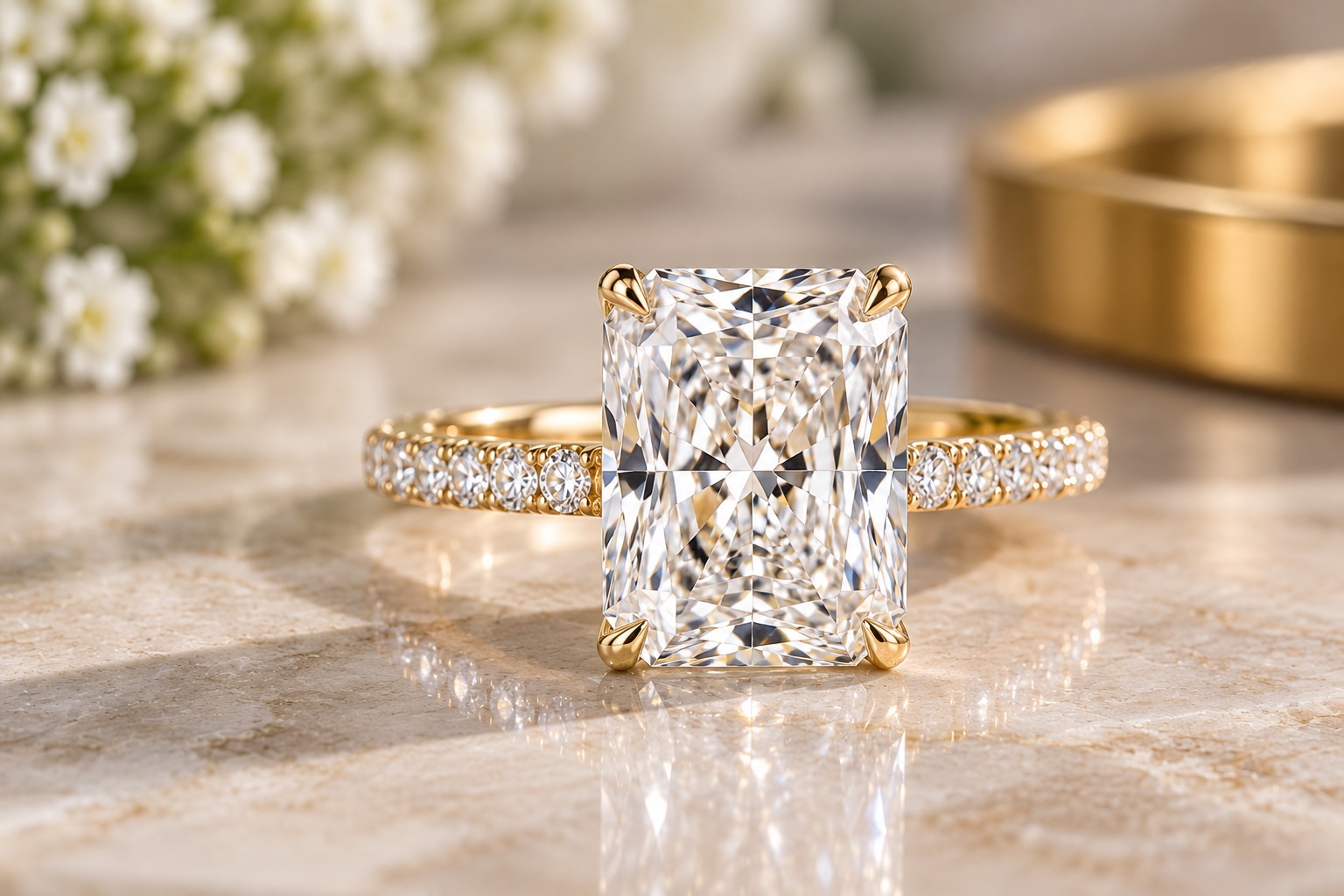
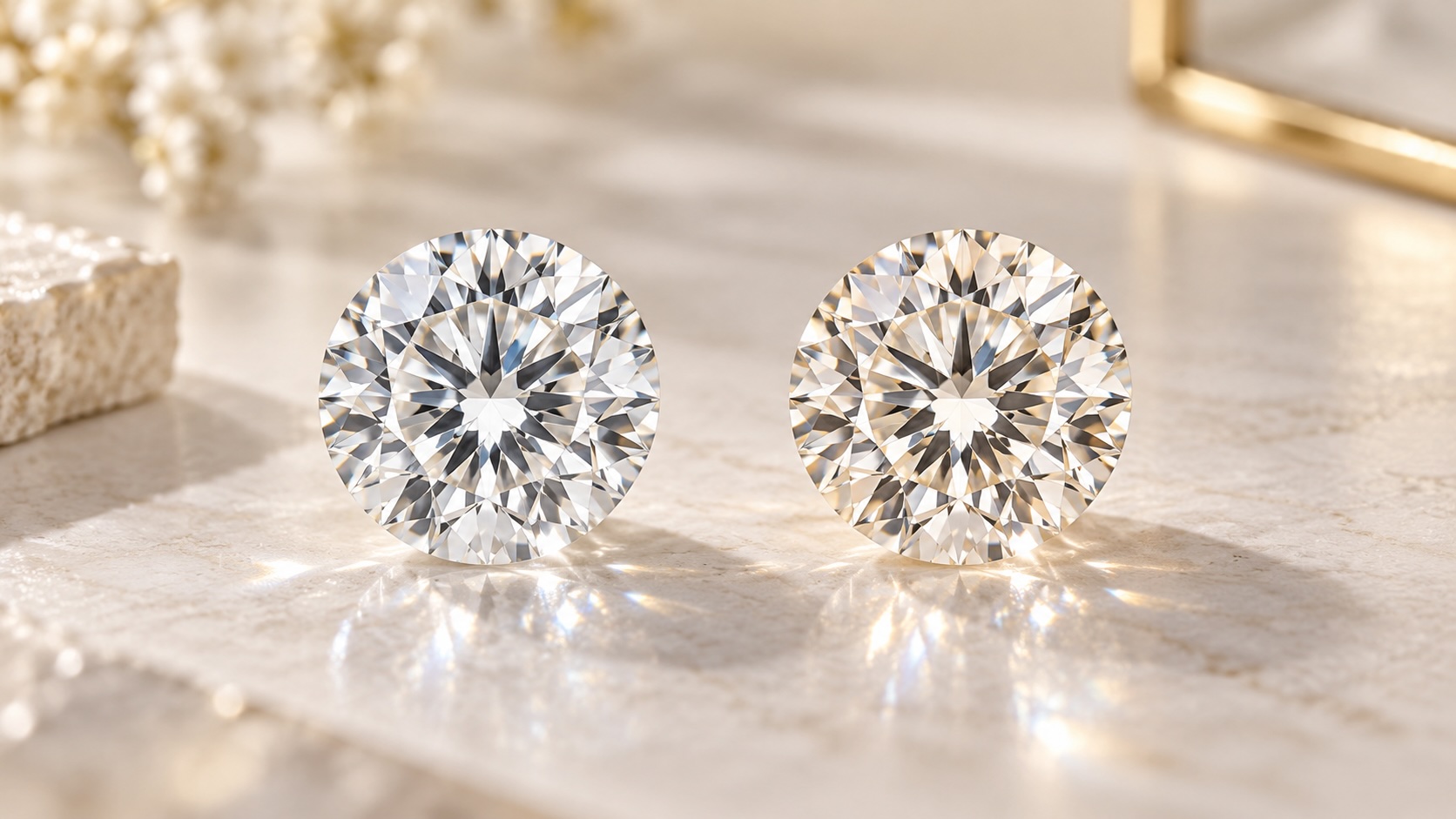
G and H color diamonds sit next to each other on the diamond color scale, and both fall within the near-colorless range.
For most engagement ring shoppers, the visual difference between them is small.
The price difference can be more meaningful.
That makes the G vs H decision less about which grade is technically “better” and more about whether paying extra for G produces enough visible improvement to justify the cost.
For most buyers, my answer is:
H color usually offers better value.
A well-cut H color diamond can appear beautifully white once set in an engagement ring, particularly in round brilliant cuts. G color is worth considering if you are especially sensitive to warmth, buying a larger diamond, choosing a shape that retains more color, or setting the diamond in platinum or white gold.
Let’s look at the differences properly.
G vs H Color Diamonds at a Glance
| G Color | H Color | |
|---|---|---|
| GIA category | Near-colorless | Near-colorless |
| Face-up appearance | Very white | Very white in many diamonds |
| Visible warmth | Minimal | Slightly more possible |
| Price | Higher | Lower |
| Best for | Color-sensitive buyers | Value-focused buyers |
| White gold/platinum | Excellent | Usually excellent |
| Yellow/rose gold | Excellent | Excellent |
| My value choice | Good | Better |
The important point is that G and H are neighboring grades.
You are not comparing a colorless diamond with an obviously warm diamond.
You are comparing two grades that can look extremely similar without controlled side-by-side viewing.
What Is a G Color Diamond?
G is the highest grade within the GIA near-colorless category.
The GIA color scale runs from:
D to Z
with D representing the least detectable body color and increasing amounts of yellow or brown becoming more noticeable farther down the scale.
G sits immediately below the colorless D-F range.
This makes G popular with buyers who want a diamond that appears very white but do not want to pay the premium associated with D, E, or F.
A well-cut G color round brilliant can look colorless to many people once mounted.
You can learn more about the full scale in my diamond color guide.
What Is an H Color Diamond?
H is one grade below G and is also classified as near-colorless.
In isolation, a good H color diamond often appears impressively white.
A trained observer may notice slightly more warmth when comparing an H directly against a higher-color diamond under controlled lighting, particularly from the side.
That does not necessarily mean that warmth will be obvious in an engagement ring.
This is why H is frequently one of my preferred value grades.
You are still buying a high color grade, but you are spending less money on an attribute that may provide very little visible difference once the diamond is actually worn.
Can You See the Difference Between G and H?
Sometimes, but it depends heavily on the diamond and the viewing conditions.
Place a loose G and H diamond upside down against a white background under controlled lighting, and you may be able to identify a difference.
That is essentially how professional color grading works.
An engagement ring is a completely different environment.
The diamond is:
- Viewed face-up
- Reflecting surrounding light
- Mounted in metal
- Constantly moving
- Producing brightness, fire, and scintillation
These effects can make subtle differences in body color much harder to detect.
With a well-cut round brilliant, many buyers would struggle to reliably distinguish G from H once the diamonds are mounted.
Cut Quality Matters More Than G vs H
This is one of the biggest mistakes buyers make.
They spend extra money moving from H to G, or even from G into the D-F range, while compromising on cut.
I would rather own:
H color with exceptional cut quality
than:
G color with mediocre cut quality.
Cut determines how effectively a diamond handles light.
A beautifully cut diamond can produce stronger:
- Brightness
- Fire
- Scintillation
- Contrast
- Edge-to-edge light return
That visual performance usually has a much greater impact on beauty than moving a single color grade higher.
If your budget forces you to choose between improving color or improving cut, I would normally prioritize cut.
Read my diamond cut guide for more detail.
Where I Would Compare G and H Diamonds
For buyers who prioritize cut quality, I would start with Whiteflash.
Its in-house A CUT ABOVE® diamonds make it particularly easy to compare G and H color stones while keeping cut quality consistently high. That allows you to judge whether moving from H to G actually provides enough visible benefit to justify the additional cost.
You can also read my full Whiteflash review.
Which Looks Whiter: G or H?
Technically, G.
It is one grade higher on the color scale.
But the more useful question is:
Will G look noticeably whiter in the finished ring?
Often, the answer is no.
The difference becomes more noticeable when:
- The diamond is large
- The shape retains more body color
- The diamond is viewed from the side
- The setting uses white metal
- You are particularly sensitive to color
- G and H stones are directly compared
Without those conditions, H can provide almost the same overall impression for less money.
G vs H in Round Brilliant Diamonds
Round brilliants are one of the easiest shapes in which to save money on color.
A well-cut round returns a large amount of light to the viewer, helping disguise subtle body color.
For many buyers, H is the sweet spot.
If I were buying a well-cut round brilliant in the roughly 1 to 2 carat range, I would be very comfortable considering H.
G becomes more appealing if you:
- Want a particularly icy-white appearance
- Are very color-sensitive
- Are using platinum
- Are buying a larger stone
- Simply prefer the reassurance of the higher grade
But I would not automatically pay more for G without first comparing an excellent H.
G vs H in Oval Diamonds
Ovals require slightly more caution.
They can show body color more readily than round brilliants, particularly near the pointed ends.
An H color oval can still look excellent, but the actual diamond should be assessed visually.
If two ovals are otherwise equally attractive and the price difference is reasonable, I may lean toward G more readily than I would with a round.
That said, cut appearance and bow-tie severity still matter more than chasing a single color grade.
G vs H in Radiant Diamonds
Radiant cuts can retain and concentrate color more noticeably than rounds.
This is one reason radiant cuts are also commonly used for fancy yellow diamonds.
For a colorless radiant engagement ring, G can be a useful choice if you are sensitive to warmth.
H can still offer excellent value, especially in:
- Yellow gold
- Rose gold
- Smaller carat weights
But I would always inspect the actual diamond rather than assuming every H radiant will face up equally white.
G vs H in Emerald and Asscher Cuts
Step cuts deserve additional attention.
Emerald and Asscher cuts have large, open facets and behave very differently from brilliant-cut shapes.
They do not create the same dense pattern of sparkle that can help mask body color.
As a result, differences between neighboring color grades can sometimes be easier to notice.
For a platinum or white gold emerald-cut engagement ring, G can make more sense if your budget allows.
H can still be a strong value choice, but inspect the diamond carefully.
What About Cushion Cuts?
Cushion cuts vary enormously.
Some cushion brilliants return a lot of light and disguise warmth effectively.
Others retain more body color.
Their deeper proportions can also influence how color presents.
For that reason, I would not make a blanket rule that all H cushions are equivalent to G.
Compare the actual images and videos.
Does Carat Weight Matter?
Yes.
Color can become more noticeable as diamonds get larger because there is simply more material through which the body color can be observed.
That means my recommendations might differ depending on size.
For example:
Around 0.50 to 1 Carat
H is an excellent value choice for many shapes, particularly rounds.
Around 1 to 2 Carats
H remains very strong for well-cut rounds. G becomes increasingly worth comparing in shapes that retain more color.
2 Carats and Above
Color becomes more noticeable, so I would examine the difference between G and H more carefully.
That does not automatically mean buying G.
It simply means the actual diamond matters more.
White Gold and Platinum: G or H?
White metals provide a neutral backdrop.
This can make warmth easier to notice than with yellow or rose gold.
Even so, I would still be comfortable recommending H for many round brilliant diamonds in white gold or platinum.
If you are extremely sensitive to warmth, G provides an extra margin of safety.
For shapes such as:
- Emerald
- Asscher
- Radiant
- Oval
I would compare G and H directly before deciding.
Yellow Gold: G or H?
H is particularly attractive in yellow gold.
The surrounding metal already has a warm tone, so paying a significant premium for a higher color grade often makes less sense.
You may even be able to go below H depending on:
- Diamond shape
- Setting style
- Personal preference
- How the prongs are colored
A common strategy is to use yellow gold for the band but white gold or platinum prongs around the center diamond.
This keeps the area immediately around the stone neutral while maintaining the warmer appearance of the ring.
Between G and H, I would usually choose H in yellow gold and put the saving toward cut quality or carat weight.
Rose Gold: G or H?
The same principle applies to rose gold.
The warm surrounding metal makes subtle body color less important.
Unless you specifically want an extremely icy-white center diamond for contrast, H usually provides excellent value.
How Much Can You Save Choosing H Instead of G?
There is no fixed percentage.
Diamond prices depend on multiple characteristics simultaneously:
- Carat
- Cut
- Clarity
- Shape
- Certification
- Fluorescence
- Proportions
- Market availability
Two diamonds differing only by one color grade can still have substantially different prices because other characteristics are not identical.
The important point is that dropping from G to H can free up budget without causing a similarly large reduction in visible beauty.
That money might be better spent moving from:
- Good cut to exceptional cut
- 0.90 carat to 1 carat
- 1.5 carats to a slightly larger stone
- A basic setting to your preferred setting
This is why H is so compelling from a value perspective.
G VS2 vs H VS1: Which Should You Choose?
This is a common type of comparison.
Imagine choosing between:
G color, VS2 clarity
and:
H color, VS1 clarity
Which is better?
Neither automatically.
If both diamonds are eye-clean, the higher VS1 clarity may offer no visible advantage.
Likewise, the difference between G and H may be very subtle.
I would evaluate:
- Cut quality
- Light performance
- Face-up appearance
- Whether the inclusion is visible
- Price
Only then would I use the color and clarity grades as tie-breakers.
Do not pay for specifications that you cannot appreciate without magnification.
My diamond clarity guide explains this in more detail.
Compare the Actual Diamonds
If you want a large inventory for comparing G and H diamonds side by side, Blue Nile is useful because you can filter across a wide range of carat weights, color grades, and clarity combinations.
Brilliant Earth is another strong option if you want to compare both natural and lab-grown diamonds alongside a large range of engagement ring settings.
Read my Blue Nile review and Brilliant Earth review before buying.
G vs H Lab-Grown Diamonds
The value calculation changes somewhat with lab-grown diamonds.
Because lab-grown diamond prices are significantly lower than natural diamond prices, the cost of moving from H to G may sometimes be relatively modest.
If the premium is small, choosing G can make sense.
However, I still would not sacrifice cut quality for color.
Lab-grown diamonds can also display visual characteristics that are not fully explained by a simple G or H color grade, including:
- Blue nuance
- Brown nuance
- Gray tones
- Growth-related transparency issues
This is why good imagery remains important.
A G-grade lab-grown diamond is not automatically more attractive than an H-grade stone.
Is G Color Worth the Extra Money?
It can be.
I would lean toward G when:
- You are highly color-sensitive
- You want an icy-white appearance
- You are buying a large diamond
- The diamond is an emerald, Asscher, radiant, or other color-sensitive shape
- The setting is platinum or white gold
- The price difference is relatively small
But I would not automatically choose G simply because it is the higher grade.
When Is H the Better Buy?
H is my preferred option when:
- Value is a priority
- You are buying a well-cut round brilliant
- You want to maximize carat weight
- You are using yellow or rose gold
- You cannot see a meaningful difference between G and H
- Moving to H lets you improve cut quality
This is the situation many buyers find themselves in.
The G diamond looks slightly better on paper.
The H diamond looks virtually identical on the hand.
In that situation, I would save the money.
Frequently Asked Questions
Is G or H color better?
G is technically the higher color grade, but H often provides better value.
Both are classified as near-colorless.
Can you tell the difference between G and H diamonds?
Sometimes, particularly when comparing loose diamonds side by side under controlled lighting.
Once set in a ring, the difference can be very difficult to see, particularly in well-cut round diamonds.
Does H color look yellow?
A properly graded H diamond should not normally look obviously yellow.
It may show a subtle degree of warmth compared with higher grades, particularly from the side or in certain shapes.
Is H color good enough for platinum?
Yes.
A well-cut H round brilliant can look excellent in platinum.
Color-sensitive buyers or those choosing shapes that retain more color may prefer G.
Is G color considered colorless?
Technically, no.
G is the highest grade within the GIA near-colorless range.
D, E, and F are classified as colorless.
Is G color worth it over H?
It depends on the price difference and your sensitivity to color.
If the diamonds look almost identical and the H is meaningfully cheaper, I would usually choose H.
Is H color good for an engagement ring?
Yes.
H is one of my favorite value grades for engagement rings because it balances a very white appearance with a lower price than higher color grades.
Should I choose better color or better clarity?
Once a diamond is eye-clean, improving clarity may offer little visible benefit.
Likewise, moving from H to G may provide only a small visual improvement.
Prioritize cut first, then find the best balance of color and eye-clean clarity within your budget.
Final Verdict: G vs H Color Diamonds
For most buyers, H color offers the better value.
It sits comfortably within the near-colorless range and can appear beautifully white, especially in a well-cut round brilliant.
G provides an additional degree of whiteness and can be worth paying for if you are:
- Color-sensitive
- Buying a larger diamond
- Choosing a step cut or color-retaining shape
- Using platinum or white gold
- Happy to pay the premium
But I would never compromise cut just to move from H to G.
For quality-focused buyers, I would start with Whiteflash and compare G and H diamonds with similarly strong cut quality.
For a much larger searchable inventory, Blue Nile makes it easy to compare multiple specifications and price points.
And if you want to compare natural and lab-grown options alongside a broad range of ring designs, Brilliant Earth is also worth considering.
If two diamonds are equally well cut and you cannot see a meaningful difference between them, choose the H and keep the saving.
The certificate may say the G is one grade higher.
Your eyes may tell you that the H is the smarter diamond.

I’m Louis Jacobs, the creator of Diamond Expert, a platform where I share my lifetime’s knowledge of diamonds. Born and raised in Antwerp, Belgium, the world’s diamond hub, my fascination with these precious gems began at a young age. I spent over three decades in the diamond industry, earning the reputation of a trusted advisor among friends and family for diamond purchases, particularly engagement rings. Now retired, I’m dedicated to providing online guidance to make your diamond buying experience informed and successful.