A feather is one of the most common clarity characteristics found in diamonds. Despite the delicate name, a diamond feather is essentially a small fracture or separation within the diamond crystal that can resemble a white feather when viewed under magnification.
That description sounds alarming, particularly when you are considering a diamond for an engagement ring that may be worn every day for decades.
But the presence of a feather does not automatically make a diamond fragile.
Many VS and SI diamonds contain feathers that have no meaningful effect on durability. They may be completely invisible without magnification and remain safely enclosed within the diamond.
The concern increases when a feather is:
- Large
- Surface-reaching
- Positioned at or near the girdle
- Located close to a pointed corner
- Associated with an extremely thin area of the diamond
- Significant enough to influence a low clarity grade
For most buyers, the right question is therefore not:
“Does this diamond have a feather?”
It is:
“Where is the feather, how large is it, and could it create a structural weakness during normal wear or setting?”
This guide explains how to answer that question.
If you are new to diamond inclusions, start with my complete diamond clarity guide and guide to the 4Cs.
Diamond Feathers at a Glance
| Feather Characteristic | Durability Concern |
|---|---|
| Tiny, fully internal feather | Usually very low |
| Small VS-grade feather | Usually low |
| Eye-clean SI1 feather | Depends on location and size |
| Large feather near the girdle | More concerning |
| Feather reaching the surface | Requires careful evaluation |
| Feather near a princess, pear, or marquise point | More concerning |
| Feather beneath the table but fully internal | Often more of a visibility issue |
| Multiple large feathers | Requires closer assessment |
| Feather contributing to an I clarity grade | Higher risk of durability or transparency issues |
The clarity grade alone does not determine whether a feather is safe.
A VS2 diamond with a strategically positioned feather may be completely suitable for everyday wear, while a lower-graded stone with a large surface-reaching feather could deserve much more caution.
The individual inclusion matters.
What Is a Feather Inclusion in a Diamond?
A diamond feather is a fracture or cleavage-related separation inside the diamond crystal.
When viewed under magnification, the inclusion can have a feathery or wispy appearance, which is where the name comes from.
Some feathers appear white.
Others may be almost transparent and difficult to see unless the diamond is tilted to a particular angle.
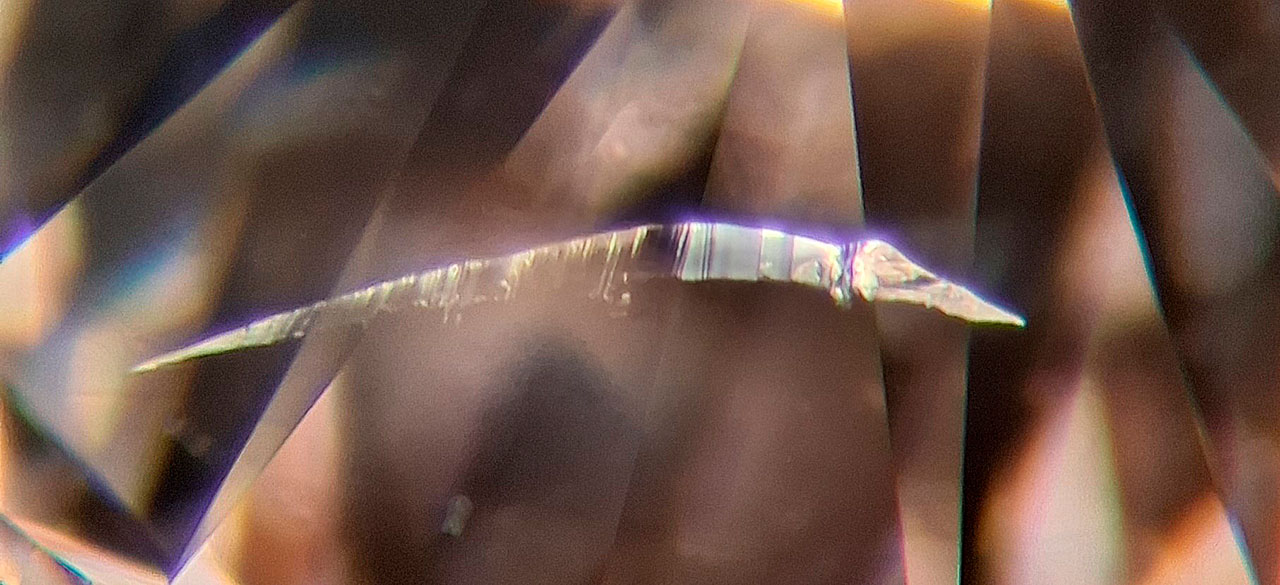
A feather in a 0.30 ct diamond with I1 clarity
A feather can be:
- Completely internal
- Close to the surface
- Surface-reaching
- Small and isolated
- Large and extended
- Associated with the girdle or another vulnerable area
This variation explains why the word feather alone tells you very little about whether a particular diamond is a good purchase.
Two diamonds can both list “feather” as a clarity characteristic and still have completely different risk profiles.
One might contain a tiny internal feather visible only to an experienced grader at 10x magnification.
The other could contain a long fracture reaching the girdle.
Those should not be treated as equivalent diamonds simply because the grading reports use the same inclusion name.
Are Feather Inclusions Dangerous?
Most feather inclusions are not dangerous to the diamond during normal wear.
Diamonds naturally contain clarity characteristics, and many diamonds with feathers are set into engagement rings and worn successfully for decades.

The risk depends primarily on:
- Size
- Depth
- Location
- Whether the feather reaches the surface
- Diamond shape
- Girdle thickness
- Overall severity of the inclusion
A small internal feather surrounded by solid diamond crystal is very different from a large fracture extending to the outer edge of the stone.
This is why an automatic rule such as:
“Never buy a diamond with a feather”
would eliminate many perfectly good diamonds unnecessarily.
It could also force you to pay for a much higher clarity grade without receiving a visible improvement.
My goal when buying clarity is normally to find an eye-clean and structurally sound diamond, not to eliminate every microscopic inclusion.
That philosophy is particularly important when comparing VS2 diamonds and SI1 diamonds, where significant value can sometimes be found.
When Does a Diamond Feather Become a Durability Risk?
A feather becomes more concerning when it creates a potential weak point that could be affected by pressure or impact.
The four characteristics I care about most are:
1. The Feather Reaches the Surface
A completely internal feather is generally less concerning than one that opens at the surface of the diamond.
A surface-reaching fracture creates a location where an impact or pressure could potentially affect the existing separation.
This does not mean every surface-reaching feather will expand or cause the diamond to break.
It simply deserves more scrutiny.
2. The Feather Is Near the Girdle
The girdle forms the outer perimeter of the diamond.
It is also an area that can receive pressure from prongs during setting and occasional knocks during wear.
A large feather reaching the girdle therefore concerns me more than a similar inclusion buried safely inside the stone.
3. The Feather Is Large
Size matters.
A tiny feather responsible for a VS clarity grade is very different from a major feather extending through a significant portion of an SI2 or I1 diamond.
4. The Feather Is Near a Vulnerable Point
Princess, pear, marquise, and some other fancy-shaped diamonds contain pointed corners or tips.
Those areas already require additional protection.
A significant feather near one of those points deserves careful professional evaluation before purchase.
Where I Recommend Buying Diamonds With Detailed Clarity Information
Whiteflash is my first choice when detailed diamond evaluation is particularly important. Its in-house approach and extensive diamond imagery can be especially useful when you need more information about individual clarity characteristics. Read my full Whiteflash review.
Blue Nile provides a much larger inventory and is useful for comparing multiple diamonds within the same clarity and price range. Read my Blue Nile review.
Brilliant Earth is also worth comparing if you want a broad choice of natural and lab-grown diamonds alongside a large engagement ring selection. Read my Brilliant Earth review.
With any feather inclusion, ask about durability and location, not simply whether the diamond is eye clean.
Why Feathers Near the Girdle Need More Attention
The location of a feather can be more important than how visible it is.
A small dark crystal directly beneath the table may be visually distracting but present no meaningful structural issue.
A translucent feather near the girdle might be much harder to see yet deserve more attention from a durability perspective.
The girdle is where the crown and pavilion meet, forming the outside edge of the diamond.
It is significant because:
- Prongs are often positioned around it
- The diamond can receive impacts there
- Extremely thin girdles are inherently more vulnerable
- A surface-reaching inclusion can create another point of weakness
This becomes particularly important if several risk factors occur together.
For example:
Large feather + extremely thin girdle + exposed location
would concern me considerably more than:
Small internal feather + medium girdle + protected position
Do not rely on the magnified product photograph alone.
A feather can look enormous at 20x or 40x magnification even though it is microscopic in reality.
Instead, use the grading report, inclusion plot, actual video, and preferably expert inspection to understand its true significance.
Surface-Reaching Feathers Require Individual Assessment
A surface-reaching feather is exactly what the term suggests: the fracture intersects with the outside surface of the diamond.
That deserves attention, but it is not automatically a reason to reject the stone.
The important questions are:
- Where does it reach the surface?
- How large is the opening?
- How far does the feather extend?
- Is it near the girdle?
- Will the setting place pressure near it?
- Is it located at a vulnerable corner?
- Does a qualified jeweler consider it structurally significant?
A small surface-reaching feather in a relatively protected position could still be acceptable.
A substantial fracture opening around the girdle of a large everyday engagement-ring diamond is a different proposition.
This is one of the situations where professional inspection is much more valuable than internet guesswork from a magnified photograph.
An experienced gemologist or jeweler can examine the stone from multiple angles and consider how it will interact with the proposed setting.
Feathers Near Diamond Points Can Be More Concerning
Some diamond shapes contain areas that are naturally more vulnerable to chipping.
Examples include:
- Princess-cut corners
- Pear-shaped points
- Marquise tips
A diamond is extremely hard, but hardness describes resistance to scratching. It does not mean a diamond cannot chip.
A strong impact at the wrong angle can damage a vulnerable edge or point.
A significant feather located close to one of these areas adds another factor to consider.
Suppose two marquise diamonds are otherwise comparable.
Diamond A: Small feather beneath the table, completely internal.
Diamond B: Larger feather extending toward one pointed tip.
I would be much more interested in professional durability assessment for Diamond B.
The setting also becomes important.
Protective V-prongs are commonly used around pointed diamonds because they shield the most vulnerable areas from direct impact.
If an inclusion sits near that point, the jeweler also needs to ensure that setting pressure itself will not create unnecessary stress.
Are VS1 and VS2 Feather Inclusions Usually Safe?
In most cases, feathers in VS1 and VS2 diamonds are not something I would automatically worry about.
VS means Very Slightly Included.
At these grades, the inclusions are relatively minor when examined under 10x magnification.
A typical VS feather is therefore unlikely to resemble the dramatic “crack” shoppers sometimes imagine after reading the word on a grading report.
That said, VS2 diamonds still vary.
One VS2 could receive the grade because of several tiny crystals.
Another could be graded VS2 primarily because of a feather.
This is why I recommend looking at the actual clarity characteristics rather than assuming every VS2 diamond is identical.
My VS2 diamond guide explains why VS2 is one of my favorite value grades for many engagement rings.
If a VS2 diamond is:
- Eye clean
- Well cut
- Properly certified
- Free from structurally problematic inclusions
I would usually feel very comfortable considering it.
Should You Buy an SI1 Diamond With a Feather?
Potentially, yes.
SI1 diamonds can offer excellent value because many contain inclusions that are visible under magnification but not noticeable to the unaided eye.
A feather being responsible for an SI1 grade does not automatically make the diamond unsafe.
However, I become more selective.
At SI1 I want to know:
- Is the diamond eye clean?
- Is the feather large?
- Does it reach the surface?
- Is it near the girdle?
- Is it near a corner or tip?
- Are there several feathers?
- Does an expert believe the diamond is structurally sound?
My SI1 diamond guide explains why two diamonds with the same SI1 grade can represent completely different buying propositions.
An eye-clean SI1 with a harmlessly positioned feather can be an excellent value purchase.
An SI1 where a large feather reaches the girdle and creates a durability concern is not worth buying simply because the price looks attractive.
SI2 and I-Clarity Feathers Need More Caution
The lower you move down the clarity scale, the greater the probability that inclusions are large, numerous, visible, or potentially impactful.
That does not mean every SI2 diamond is structurally compromised.
However, I apply significantly greater scrutiny to SI2 diamonds where feathers are substantial clarity characteristics.
My SI2 diamond guide already recommends considerable caution with this grade for high-quality engagement-ring purchases.
At I1, I2, and I3 clarity, inclusions can become sufficiently significant that they may affect:
- Transparency
- Brilliance
- Appearance
- Durability
For an engagement ring that will be worn every day, there is usually enough online inventory available that I see little reason to accept obvious structural concerns.
Saving money on clarity is sensible.
Buying a potentially vulnerable diamond is not.
The objective is to find the lowest clarity grade that remains eye clean enough for your preferences and structurally sound.
Can a Feather Get Bigger Over Time?
Diamond feathers do not normally “grow” spontaneously simply because the diamond gets older.
A diamond is not gradually deteriorating under ordinary conditions.
However, an existing fracture can potentially provide a weak point if the diamond later experiences:
- A hard impact
- Significant setting pressure
- Damage near a vulnerable corner
- Improper jewelry repair or resetting
That distinction matters.
A safe internal feather is not something that should slowly spread across the diamond while the ring sits on your finger.
The concern is whether a sufficiently severe existing fracture could propagate if force is applied in an unfavorable way.
That is why location and severity matter so much.
It is also why a diamond that survives the cutting and polishing process with a minor feather is often perfectly capable of normal jewelry wear.
Do not panic simply because a grading report uses the word feather.
Evaluate the inclusion.
Can a Diamond Feather Cause the Stone to Split?
In extreme circumstances, a significant fracture could contribute to structural failure, but this is not the normal outcome for diamonds containing minor feathers.
The word fracture can make shoppers imagine a windshield crack suddenly spreading through an entire stone.
That is generally not a useful comparison.
Diamonds containing small feathers are routinely cut, polished, set, and worn successfully.
The concern becomes more realistic when the inclusion is:
- Large
- Open
- Surface-reaching
- Near a vulnerable point
- Combined with a thin girdle
- Already associated with a very low clarity grade
If a professional inspecting the diamond identifies a feather as a genuine durability risk, there is usually little reason for an ordinary engagement-ring buyer to take that risk.
There are enormous numbers of diamonds available online.
Simply choose another one.
Does an Eye-Clean Feather Mean the Diamond Is Safe?
No.
Eye clean and structurally safe are two different assessments.
Eye clean means the inclusion cannot be seen under defined normal viewing conditions without magnification.
That tells you something about appearance.
It does not necessarily tell you whether the inclusion affects durability.
Consider:
Diamond A: Dark crystal under the table visible without magnification.
Diamond B: Transparent feather reaching the girdle that is invisible without magnification.
Diamond A might be visually undesirable but structurally harmless.
Diamond B might look perfectly clean but deserve more durability scrutiny.
This is why I dislike selecting clarity only from the question:
“Can I see it?”
You should also ask:
“What is it and where is it?”
The best diamond is not merely eye clean.
It is eye clean and structurally suitable for the way it will be worn.
How to Read a Feather on a Diamond Grading Report
A grading report can provide useful clues about diamond feathers.
My guide on how to read a diamond grading report explains the broader document in detail.
Where an inclusion plot is provided, a feather may be shown using the laboratory’s corresponding plotting symbol.
The plot can help you understand:
- Approximate location
- Apparent extent across the plotted view
- Whether multiple feathers are present
- Relationship to other inclusions
But there are limitations.
A two-dimensional plot cannot perfectly communicate the three-dimensional depth and orientation of a fracture inside a diamond.
Nor does the size of a symbol necessarily translate directly into durability risk.
The report is therefore a screening tool, not the final diagnosis.
Use it to identify which diamonds deserve closer examination.
Then combine the report with:
- High-resolution photography
- Rotating video
- Magnified imagery
- Expert inspection
If you are buying a substantial diamond, asking a qualified person to physically inspect a potentially concerning feather is worth doing.
A Large Inclusion Plot Does Not Automatically Mean a Dangerous Diamond
Clarity plots can look frightening.
Remember that they are diagrams designed to record tiny characteristics that may otherwise be difficult or impossible to see.
A red feather symbol can occupy a noticeable section of a grading diagram even when the real inclusion is invisible without magnification.
Do not assess the diamond by the visual drama of the plot.
Instead, determine:
- What inclusion is being shown?
- Where is it?
- Is it visible?
- Does it reach the surface?
- Is there any structural concern?
This same principle applies to other inclusions.
The plot tells you where to look.
It does not replace looking.
My broader diamond certification guide explains why the grading report should always be combined with actual-diamond assessment.
Compare Diamonds Before Accepting a Feather Inclusion
If you are deciding between diamonds with different clarity characteristics, compare the complete stones rather than choosing solely by clarity grade.
I recommend starting with Whiteflash when detailed diamond evaluation and cut information are priorities. Read my Whiteflash review.
Blue Nile is particularly useful for comparing a large number of diamonds around the same carat, color, and clarity specifications. Read my Blue Nile review.
Brilliant Earth provides another large selection of natural and lab-grown diamonds alongside extensive engagement ring options. Read my Brilliant Earth review.
If a significant feather is present, ask whether it is surface-reaching, near the girdle, or considered a durability concern before purchasing.
Can a Prong Cover a Feather Near the Girdle?
Sometimes buyers are told that an edge inclusion can simply be hidden beneath a prong.
Visually, that can work extremely well.
A small inclusion near the perimeter may become completely invisible once covered by the setting.
Structurally, however, the answer requires more care when the inclusion is a feather.
A prong applies pressure to the diamond during setting.
If a significant fracture reaches the girdle exactly where a prong needs to sit, placing pressure directly over that weak point may not be desirable.
A skilled jeweler can assess whether:
- The feather can safely be protected
- The prong should be placed elsewhere
- The inclusion creates unacceptable setting risk
Do not independently decide that a prong will “fix” a durability concern.
Ask the jeweler who will actually set the stone.
For harmless edge inclusions, strategic prong placement can be very useful.
For structurally concerning fractures, another diamond is often the easier solution.
Feather Inclusions in Round Brilliant Diamonds
Round brilliant diamonds are relatively forgiving when it comes to clarity.
Their complex facet pattern and strong scintillation can help conceal many small inclusions.
That makes VS2 and carefully selected SI1 round diamonds particularly attractive for value-conscious buyers.
With a round brilliant feather, I would look primarily at:
- Size
- Whether it reaches the girdle
- Surface exposure
- Clarity grade
- Whether the diamond is eye clean
Round diamonds do not have sharp pointed corners, removing one of the durability concerns associated with princess, pear, and marquise stones.
That does not make every feather harmless.
A major surface-reaching fracture around the girdle still deserves caution.
For round diamonds, I would also avoid becoming so focused on clarity that cut quality is neglected.
A flawless poorly cut diamond can be far less impressive than a beautifully cut VS2 containing a microscopic harmless feather.
Read my diamond cut guide before spending unnecessarily on extremely high clarity.
Feather Inclusions in Princess-Cut Diamonds
Princess diamonds deserve additional caution because their four sharp corners are already structurally vulnerable.
A significant feather located near one of those corners can therefore be particularly undesirable.
The setting should protect the corners effectively, typically using prongs designed to cover the points.
When reviewing a princess-cut diamond, I would want to know:
- Is there a feather near a corner?
- Does the feather reach the surface?
- How thin is the girdle near that corner?
- Can the jeweler safely secure the diamond?
- Does the grading report indicate other significant inclusions nearby?
A centrally located, fully internal feather might be perfectly acceptable.
A large corner-reaching feather is a different situation.
This illustrates why clarity characteristics should always be interpreted in the context of diamond shape.
The same inclusion type can present different risks depending on where it occurs.
Feather Inclusions in Pear and Marquise Diamonds
Pear and marquise diamonds also contain pointed ends that require protection.
For these shapes, I pay particular attention to feathers located around the tips.
The point of a pear or either end of a marquise already concentrates force into a small area if the diamond is struck.
A significant feather in that region could add unnecessary vulnerability.
A good setting normally uses protective prong designs around the points.
However, the jeweler still needs to assess whether setting pressure can be applied safely.
Feathers through the broader belly of the diamond may present an entirely different risk profile.
For fancy shapes, actual imagery becomes especially important because the certificate cannot tell you whether the diamond has an attractive facet pattern or bow tie either.
Do not spend so much time examining the clarity plot that you forget to assess the rest of the stone.
Feather Inclusions in Emerald and Asscher Diamonds
Emerald and Asscher diamonds introduce a different concern: visibility.
Their broad step facets and open tables provide a relatively unobstructed view into the diamond.
That means a feather that might disappear among the reflections of a round brilliant can be much easier to notice in a step cut.
As a result, buyers often choose somewhat higher clarity grades for emerald and Asscher diamonds.
A feather can therefore present two independent questions:
- Can I see it?
- Does it affect durability?
A central internal feather might be completely structurally harmless but visually obvious through an emerald cut’s table.
Conversely, a subtle edge feather could be visually unobtrusive but require closer durability evaluation.
Do not assume those issues are the same.
For step cuts, I would prioritize a stone that is:
- Eye clean to your standards
- Structurally sound
- Transparent
- Visually crisp
Paying for higher clarity can be more justified here than with a round brilliant.
Can Feather Inclusions Affect Diamond Sparkle?
A small feather will normally have little or no meaningful effect on brilliance.
However, a sufficiently large or extensive inclusion can interfere with transparency and light transmission.
At that point, the issue is no longer simply whether you can see a small mark.
The entire stone may begin to look:
- Hazy
- Milky
- Sleepy
- Less crisp
This is more likely to become relevant at lower clarity grades or where numerous inclusions combine.
Cut quality remains the principal determinant of diamond light performance, but exceptional cutting cannot completely overcome serious transparency problems.
That means the ideal buying combination is:
Excellent cut + good transparency + acceptable clarity + structural soundness
rather than maximizing only one characteristic.
My diamond clarity guide explains how number, size, position, relief, and type of inclusions contribute to clarity assessment.
Is a Feather Better Than a Dark Crystal Inclusion?
There is no universal hierarchy where one inclusion type is always better than another.
It depends on the individual diamond.
A small feather safely buried within the diamond may be preferable to a highly visible black crystal beneath the table.
But a tiny dark crystal near the edge could be preferable to a major surface-reaching fracture.
Compare:
Visibility
and
durability
separately.
The best inclusion is usually the one you cannot see and do not need to worry about structurally.
This is why shopping by clarity grade alone is ineffective.
Two SI1 diamonds can receive the same grade for completely different reasons.
One may be a fantastic engagement-ring diamond.
The other may have inclusions you would rather avoid.
Should You Pay More to Avoid Feathers Completely?
Usually, no.
There is little reason to reject every diamond containing a feather and move automatically to VVS or flawless clarity.
Doing so could add a substantial premium without producing any visible difference.
For many buyers, VS2 provides an excellent combination of:
- Clean appearance
- Low durability risk
- Sensible pricing
Carefully selected SI1 diamonds can provide even better value.
I would rather spend additional money improving:
- Cut quality
- Carat weight
- Setting quality
than purchasing microscopic clarity that cannot be appreciated without magnification.
The exception is when the available lower-clarity stones contain inclusions you do not feel comfortable with.
Never buy a diamond merely because someone tells you a risky-looking feather is “probably fine.”
There are too many alternatives available online.
Natural vs. Lab-Grown Diamond Feathers
Both natural and lab-grown diamonds can contain clarity characteristics.
Their formation processes differ dramatically, which means the types and appearances of inclusions commonly encountered can differ as well.
From a buying perspective, however, the underlying rule remains straightforward:
Evaluate the individual clarity characteristic rather than assuming origin guarantees quality.
A lab-grown diamond should still be checked for:
- Clarity
- Transparency
- Structural concerns
- Cut
- Color
- Certification
The same is true for a natural diamond.
Lab-grown pricing may make high clarity grades relatively inexpensive, but that does not eliminate the need to inspect the actual stone.
Likewise, a naturally formed inclusion does not make a natural diamond defective.
Inclusions are part of how diamonds are graded and differentiated.
My Feather Inclusion Buying Checklist
If a diamond contains a feather, I would work through the following questions before buying.
Is the diamond eye clean?
If not, decide whether the visible inclusion bothers you.
What clarity grade is it?
VS feathers generally require less concern than major inclusions in low clarity grades, but grade alone is not enough.
Where is the feather?
Central, internal feathers create a different situation from feathers around the girdle or pointed corners.
Does it reach the surface?
Surface-reaching feathers deserve closer investigation.
How large is it?
Do not judge solely from an enlarged photograph.
Is it near a thin girdle?
Multiple vulnerability factors together matter more.
Will a prong contact it?
Ask the jeweler.
Is the diamond transparent?
Make sure inclusions are not collectively producing haze.
Has an expert physically assessed it?
For an expensive diamond with a potentially significant feather, professional inspection is worth having.
When I Would Buy a Diamond With a Feather
I would be comfortable buying a diamond with a feather when:
- The feather is minor
- The diamond is structurally sound
- It is eye clean to my standards
- There is no meaningful surface-reaching concern
- The feather is not dangerously positioned
- The setting can safely accommodate the diamond
- The overall diamond offers strong value
A VS2 containing a small harmless feather can be exactly the type of diamond I would recommend.
It allows the buyer to avoid paying premiums for VVS or flawless clarity while receiving the same visible appearance.
That is smart clarity buying.
When I Would Walk Away
I would normally choose another diamond when a feather is:
- Large and surface-reaching
- Extending substantially through the girdle
- Located at a vulnerable point
- Associated with an extremely thin girdle
- Considered a durability risk by an experienced gemologist
- Contributing to obvious transparency problems
- Making the diamond visibly unattractive
I would also walk away if the retailer cannot give me a clear answer about a concerning inclusion.
Buying a diamond should not involve gambling on whether a significant fracture will be fine.
There are thousands of alternatives available.
Frequently Asked Questions About Diamond Feather Inclusions
Is a feather a crack in a diamond?
A feather is a fracture or separation within the diamond crystal.
The term reflects its feather-like appearance under magnification.
Not every feather presents a durability risk.
Are diamond feathers bad?
Not necessarily.
Small internal feathers are common clarity characteristics and can be completely harmless.
Size, location, and whether the feather reaches the surface are much more important.
Can a feather make a diamond break?
A significant fracture in a vulnerable location could potentially increase the risk of damage following impact or setting pressure.
Minor feathers normally do not mean the diamond is going to break.
Is a VS2 feather safe?
Frequently, yes.
VS2 inclusions are relatively minor, but the individual diamond should still be assessed.
Should I buy an SI1 diamond with a feather?
An eye-clean SI1 with a small, safely positioned feather can provide excellent value.
A large surface-reaching feather deserves greater caution.
Can a feather grow?
A feather does not normally expand spontaneously with age.
However, significant impact or pressure at a vulnerable existing fracture could potentially cause additional damage.
Can a prong hide a feather?
A prong may visually hide an edge feather, but the jeweler should confirm that placing pressure near the inclusion is structurally appropriate.
Can feathers affect sparkle?
Small feathers generally have little impact.
Large or numerous inclusions can potentially affect transparency and therefore the overall visual performance of the diamond.
Are feathers visible without magnification?
Some are, particularly at lower clarity grades.
Many VS feathers and some SI feathers are impossible to see with the unaided eye.
Should I avoid all surface-reaching feathers?
Not automatically, but they deserve closer professional assessment because they interact with the outside surface of the diamond.
Final Verdict: When Is a Diamond Feather a Durability Risk?
The presence of a feather on a diamond grading report should not automatically stop you from buying the diamond.
Many feathers are tiny, internal clarity characteristics with no meaningful effect on everyday durability.
The risk increases when the feather is:
- Large
- Surface-reaching
- Near the girdle
- Close to a pointed corner
- Combined with a thin or vulnerable area
- Significant enough to contribute to a low clarity grade
The key is to evaluate structure and visibility separately.
A diamond can be eye clean and still deserve durability scrutiny.
It can also contain an obvious inclusion that has no meaningful structural effect.
For most buyers, I would begin around VS2 clarity and consider carefully selected SI1 diamonds where the savings are worthwhile.
Use the diamond clarity guide to understand the inclusion, then review the grading report, actual imagery, and professional assessment before making the final decision.
For retailer comparisons, I would begin with Whiteflash if detailed diamond evaluation is the priority, compare a broader inventory through Blue Nile, and consider Brilliant Earth if you want a large selection of natural and lab-grown diamonds.
The most useful rule is simple:
Do not reject a diamond because it has a feather. Reject it if the feather makes that particular diamond visually or structurally unsuitable.

I’m Louis Jacobs, the creator of Diamond Expert, a platform where I share my lifetime’s knowledge of diamonds. Born and raised in Antwerp, Belgium, the world’s diamond hub, my fascination with these precious gems began at a young age. I spent over three decades in the diamond industry, earning the reputation of a trusted advisor among friends and family for diamond purchases, particularly engagement rings. Now retired, I’m dedicated to providing online guidance to make your diamond buying experience informed and successful.