Four-prong and six-prong settings are two of the most common ways to secure a center diamond in an engagement ring. At first glance, the difference appears simple: one setting uses four pieces of metal to hold the diamond, while the other uses six.
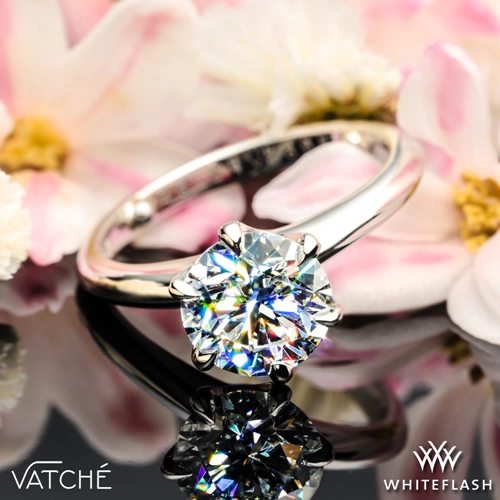
Platinum Vatche U-113 6-Prong Solitaire Engagement Ring from Whiteflash
In practice, those two additional prongs affect security, appearance, maintenance, and how much of the diamond remains visible.
If security is the main priority, a six-prong setting generally has the advantage. Six contact points provide greater redundancy, so if one prong becomes damaged or loses contact with the diamond, five others remain.
A four-prong setting still provides good security when it is well designed and maintained. Its main advantages are a cleaner appearance, less metal around the diamond, and a slightly more open view of the stone.
For most buyers, the choice can be simplified:
Choose six prongs if maximum security is your priority. Choose four prongs if you prefer a more minimal setting that exposes more of the diamond.
The right decision also depends on diamond size, shape, setting quality, lifestyle, and how often the ring will be inspected.
If you are still choosing the center stone, start with my guide to the 4Cs and diamond cut guide before deciding on the setting.
Four Prongs vs. Six Prongs at a Glance
| Four-Prong Setting | Six-Prong Setting | |
|---|---|---|
| Security | Very good | Excellent |
| Prong redundancy | Four contact points | Six contact points |
| Diamond visibility | More exposed | Slightly more metal |
| Round diamond appearance | Can look slightly squarer | Emphasizes round outline |
| Best for smaller diamonds | Often | Can sometimes overwhelm them |
| Best for larger diamonds | Possible with a quality setting | Often preferred |
| Cleaning | Slightly more open | More areas around prongs |
| Overall style | Minimal and contemporary | Classic and secure |
| Best for maximum security | Six prongs |
Neither design should be assessed by prong count alone. Four well-made prongs can provide better real-world security than six thin or damaged prongs in a poorly constructed ring.
Craftsmanship still matters.
What Do Engagement Ring Prongs Actually Do?
Prongs are small metal supports that extend upward from the setting and bend over the edge of the diamond.
Their job is straightforward but extremely important:
Keep the diamond securely seated in the ring.
Most prong-set round brilliant engagement rings use four or six prongs. The tips are positioned over the diamond’s crown near the girdle, creating enough pressure to prevent the stone from moving while leaving most of the diamond visible.
Prongs can also have different shapes.
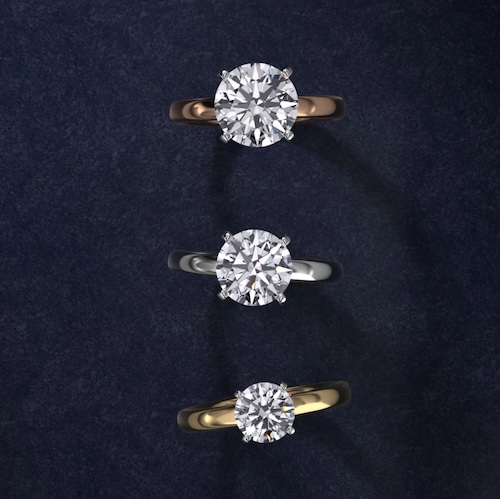
Classic Comfort Fit Solitaire Engagement Ring in 14K Yellow Gold from Blue Nile
Common options include:
- Rounded prongs
- Claw prongs
- Petite claws
- Double prongs
- V-prongs
The right style depends partly on diamond shape.
For example, V-prongs are often used to protect vulnerable pointed corners on princess, pear, and marquise diamonds.
For a round brilliant, however, the most common choice is between a traditional four-prong or six-prong head.
Why Is a Six-Prong Setting More Secure?
A six-prong setting has a simple structural advantage: redundancy.
Imagine one prong is damaged.
With a four-prong ring, the diamond has lost 25% of its primary retention points. Depending on where the damage occurs and how the remaining prongs are positioned, the diamond may become loose enough to move.
With six prongs, five remain.
That does not mean a four-prong engagement ring is unsafe. Millions of diamonds are securely worn in four-prong settings every day.
It simply means six prongs provide a larger safety margin if something goes wrong.
For someone wearing an expensive center diamond every day for decades, that additional redundancy can be valuable.
Four Prongs Still Provide Good Security
Four-prong settings should not be viewed as a risky alternative.
A properly designed four-prong mounting can hold a diamond extremely securely.
The key phrase is properly designed.
Security depends on:
- Prong thickness
- Metal quality
- How accurately the diamond is seated
- The size of the prong tips
- Prong alignment
- Setting height
- Quality of workmanship
- Ongoing maintenance
This is an important distinction because shoppers sometimes focus on the number of prongs while ignoring the quality of the ring itself.
I would rather buy a beautifully manufactured four-prong solitaire from an established jeweler than a poorly made six-prong setting simply because it contains two extra pieces of metal.
Look closely at how evenly the prongs contact the diamond.
The diamond should not move, rotate, or rattle when the ring is handled.
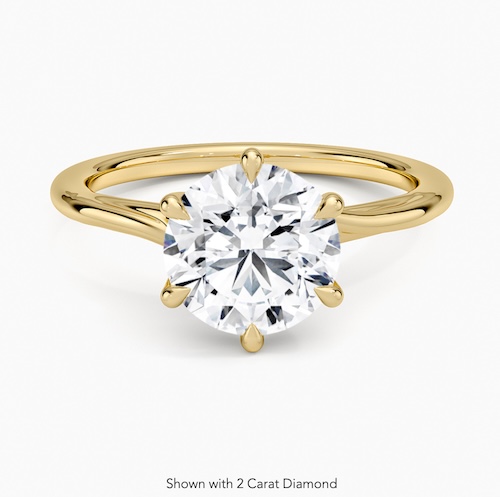
Delilah Twist Solitaire Ring in 14K Yellow Gold from Brilliant Earth
Where I Recommend Shopping for a Secure Engagement Ring
Whiteflash is my first choice for buyers prioritizing precision-cut diamonds and high-quality engagement ring settings. It is particularly worth considering if you want a premium round brilliant in a classic four or six-prong solitaire. Read my complete Whiteflash review.
Blue Nile offers a much broader selection of settings and diamonds across different budgets, making it useful for comparing four and six-prong designs. Read my Blue Nile review.
Brilliant Earth is also worth considering if you want a broad selection of natural and lab-grown diamonds combined with contemporary engagement ring designs. Read my Brilliant Earth review.
Four Prongs Show More of the Diamond
The main visual argument for a four-prong setting is simple:
There is less metal around the center stone.
With only four prongs touching the diamond, more of the girdle and crown remain unobstructed.
That can create a cleaner, more minimal appearance.
The difference can be especially appealing if you choose:
- Petite claw prongs
- A thin solitaire band
- A high-quality round brilliant
- A relatively modest center stone
However, do not exaggerate the effect.
Six well-made prongs can be extremely delicate.
A beautifully executed six-prong solitaire does not necessarily hide a significant amount of diamond.
The workmanship matters more than simply counting the prongs.
Do Four Prongs Make a Diamond Look Bigger?
They can make a diamond look slightly more exposed, which may create the impression of greater size.
But four prongs do not change the diamond’s actual face-up dimensions.
If visual size matters, pay much more attention to:
- Carat weight
- Diameter
- Diamond shape
- Depth
- Proportions
- Setting width
My diamond carat guide explains why two diamonds with the same carat weight can have different face-up dimensions.
A well-proportioned 1.00 carat round can potentially look larger than a deeper 1.00 carat diamond because more of its weight is distributed across the visible diameter rather than hidden beneath the surface.
The difference between four and six prongs is comparatively minor.
Choose four prongs because you prefer the open visual style, not because you expect them to transform the apparent size of the diamond.
Six Prongs Can Make a Round Diamond Look Rounder
Prongs can subtly influence how the eye perceives the outline of a diamond.
With four prongs positioned at roughly the cardinal points or diagonals, a round diamond can take on a slightly squarer visual framework.
Six prongs distribute the metal around the perimeter more evenly.
This can emphasize the circular outline of a round brilliant.
Some buyers like the crisp visual structure created by four prongs, while others prefer the classic rounded appearance of six.
For a precision-cut round brilliant, a finely made six-prong setting can complement the symmetry of the stone beautifully.
The differences are subtle enough that looking at actual ring photographs is much more useful than trying to imagine the effect from a description.
Does Four Prongs Let More Light Into the Diamond?
This is one of the most persistent myths surrounding engagement ring settings.
You will sometimes hear:
“Four prongs make a diamond sparkle more because more light can enter through the sides.”
That is not a good reason to choose four prongs.
The sparkle of a diamond is principally determined by cut quality, not whether the stone is held by four or six prongs.
A well-cut round brilliant is designed to collect light through its crown and return it toward the observer through carefully proportioned facets.
Changing from six prongs to four does not fix:
- Poor pavilion angles
- Excessive depth
- Light leakage
- Poor optical symmetry
- Weak facet relationships
If brilliance is the priority, concentrate on the diamond.
My diamond cut guide explains what actually determines light performance, while my diamond imaging guide covers tools such as ASET and IdealScope that can reveal how effectively a diamond handles light.
Which Is Better for a Large Diamond?
The larger and more valuable the center diamond becomes, the stronger the argument for six prongs.
A larger diamond means:
- More financial value concentrated in one stone
- More physical surface area exposed
- More leverage if the ring receives a knock
- Greater consequences if a prong fails
There is no universal carat weight at which six prongs suddenly become mandatory.
A well-made four-prong setting can securely hold a large diamond.
However, as the value and size of the stone increase, the extra redundancy becomes increasingly attractive.
If I were buying a substantial round diamond intended for everyday wear, I would lean toward six prongs unless there were a strong aesthetic reason to choose four.
Which Is Better for a Small Diamond?
Four prongs can make more sense for smaller diamonds.
On a 3 carat round diamond, six petite prongs occupy a relatively small percentage of the visible circumference.
On a 0.30 carat diamond, the same number of prongs represents much more visible metal around the stone.
For smaller center diamonds, four finely proportioned prongs can therefore provide:
- Good security
- Less visible metal
- A cleaner outline
- More emphasis on the diamond
The exact setting design still matters.
Six exceptionally fine claw prongs may look more delicate than four bulky rounded prongs.
Do not evaluate the design purely from the specification sheet.
Look at photographs of the actual setting and, ideally, examples using a center stone close to your intended carat weight.
Four vs. Six Prongs for an Active Lifestyle
Lifestyle should play a major role in setting choice.
If someone regularly:
- Exercises while wearing the ring
- Works with their hands
- Handles equipment
- Gardens
- Works around children
- Frequently catches jewelry on clothing
I would favor security over minimalism.
Between these two options, that generally means six prongs.
However, prong count is only part of the solution.
A very tall six-prong solitaire may still be more exposed than a lower-profile four-prong ring.
For someone particularly concerned about protection, a bezel setting may be worth considering because it surrounds much more of the diamond’s girdle.
Six Prongs Provide More Girdle Protection
The girdle is the outer edge of the diamond where the crown meets the pavilion.
Diamonds are extremely hard, but hardness is not the same as toughness.
A diamond can still chip if sufficient force is applied at a vulnerable point.
Six prongs provide more coverage around the girdle than four, giving the diamond additional localized protection against impacts.
This advantage is particularly relevant for a valuable diamond being worn every day.
It should not be overstated, though.
Six prongs do not create a complete protective barrier. Large areas of the girdle remain exposed.
If impact protection is your highest priority, a bezel surrounds considerably more of the diamond and may be more appropriate than either a four or six-prong solitaire.
Prong Quality Matters More Than Prong Count Alone
A six-prong ring is theoretically more secure than a comparable four-prong ring.
The important word is comparable.
Prong quality varies.
I look for:
- Evenly positioned prongs
- Consistent thickness
- Proper contact with the diamond
- Smooth finishing
- No visible gaps
- No excessively thin tips
- A diamond seated squarely in the head
Poor workmanship can undermine the theoretical advantage of extra prongs.
Metal choice matters as well.
Platinum behaves differently from gold alloys and is widely used for engagement ring heads because of its durability and naturally white appearance.
The design of the head, gallery, and connection to the shank also contribute to overall security.
This is why I recommend buying the setting from a jeweler with a strong reputation for finished jewelry, not merely shopping for the lowest-priced mounting that happens to have six prongs.
Round Diamonds Are the Classic Six-Prong Choice
The six-prong solitaire is most strongly associated with the round brilliant diamond.
The arrangement works particularly well because six evenly distributed contact points reinforce the circular outline.
Round brilliants are also where the security argument becomes especially relevant because they remain the most widely purchased center-stone shape and can reach very substantial values.
If you are buying a premium round brilliant, I would typically combine:
- Excellent cut quality
- Excellent symmetry
- A secure setting
- Appropriate insurance
- Regular prong inspections
For buyers pursuing particularly high optical precision, my Hearts and Arrows guide and guide to diamond symmetry explain what separates ordinary grading-report specifications from a truly precision-cut stone.
A valuable precision-cut center diamond deserves a setting built to an equally high standard.
Compare Four and Six-Prong Engagement Rings
For buyers who want premium round diamonds and carefully made solitaire settings, I would begin with Whiteflash. Its focus on cut quality makes it particularly relevant if you are building the ring around a high-performance round brilliant. Read my Whiteflash review.
Blue Nile is particularly useful if you want to compare a much larger range of solitaire styles, metals, diamonds, and price points. Read my Blue Nile review.
Brilliant Earth is another strong option if you are comparing natural and lab-grown center stones or want a more contemporary engagement ring design. Read my Brilliant Earth review.
What About Oval, Cushion, and Other Diamond Shapes?
The four versus six-prong question becomes less standardized once you move away from round brilliants.
Different diamond shapes have different vulnerable points.
An oval can work beautifully in four or six prongs, depending on the setting design.
Cushions often suit four prongs particularly well because the placement complements their squarish outline.
Emerald cuts commonly use four prongs positioned around the cropped corners.
Princess diamonds require special attention to their sharp corners, which are more vulnerable to chipping.
Pears and marquise diamonds often benefit from protective prongs at their pointed tips.
This means buyers should not force every diamond shape into a “four versus six” decision.
The purpose of the setting is to secure the specific diamond.
For fancy shapes, I would prioritize a setting specifically engineered for that outline over simply choosing whichever has more prongs.
Four Prongs vs. Six Prongs for Lab-Grown Diamonds
The security requirements of a lab-grown diamond are essentially the same as those of a comparable natural diamond.
A 2 carat lab-grown diamond still weighs 2 carats.
Its lower purchase price does not make secure setting design irrelevant.
In fact, lab-grown pricing means more buyers are now choosing larger center stones.
Someone whose budget previously supported a 1 carat natural diamond might instead choose a substantially larger lab-grown center stone.
That makes the physical size of the setting increasingly important.
For a large round lab-grown diamond, I would apply exactly the same logic:
Six prongs if maximizing security matters most.
Four prongs if you strongly prefer the more open appearance and the setting is properly engineered for the stone.
You should still evaluate the diamond itself using the 4Cs, appropriate certification, and actual imagery.
My diamond certification guide explains how to assess the grading documentation accompanying natural and lab-grown stones.
Do Six Prongs Make a Ring Look Old-Fashioned?
Not necessarily.
Traditional six-prong solitaires have existed for generations, so the design certainly has a classic association.
But the overall appearance depends heavily on the details.
A six-prong ring with:
- Petite claw prongs
- A thin band
- A low-profile basket
- Minimal gallery work
can look extremely contemporary.
Likewise, a bulky four-prong setting can look much heavier and more traditional.
Prong count is only one design element.
When comparing rings online, look at:
- Prong shape
- Prong thickness
- Band width
- Setting height
- Basket design
- Gallery
- Metal
- Center-stone size
The best setting is one where the prongs visually disappear into the complete design while still performing their primary job: keeping the diamond secure.
Is Four Prongs Easier to Clean?
Four-prong settings contain slightly less metal around the center stone, so there are fewer small areas where oils and residue can accumulate.
However, the difference is minor.
Both four and six-prong engagement rings need regular cleaning.
Diamonds attract grease particularly easily, and residue beneath the stone can reduce brightness even when the diamond itself has excellent cut quality.
More important than cleaning convenience is access to the underside of the diamond.
Open solitaire designs are generally straightforward to clean regardless of whether they have four or six prongs.
During cleaning, also inspect the prongs.
Look for:
- Uneven tips
- Visible gaps
- Bent prongs
- A diamond that rotates
- Rattling or movement
Do not keep wearing the ring if the center diamond feels loose.
A jeweler should inspect it promptly.
How Often Should Engagement Ring Prongs Be Checked?
Prongs are not maintenance-free.
Everyday wear exposes an engagement ring to repeated small impacts, friction, and snagging.
Even if the diamond has never suffered an obvious knock, prongs can gradually wear down.
I recommend visually checking the ring yourself regularly and having valuable engagement rings inspected professionally on a periodic basis according to your jeweler’s advice.
Pay particular attention if:
- The ring has been knocked
- A prong catches on clothing
- The stone begins moving
- One prong looks different from the others
- The ring is worn constantly
- The setting is particularly delicate
This advice applies to both four and six-prong rings.
Six prongs provide more redundancy if one fails, but they do not eliminate the need for maintenance.
The most secure setting is one that is well made and kept in good condition.
What Metal Is Best for Prongs?
Platinum and white gold are both commonly used around colorless diamonds.
Platinum is particularly popular for prongs because it is dense, naturally white, and valued for durability.
Yellow gold rings can also use a white metal head.
This creates:
yellow gold band + platinum or white gold prongs
which preserves the warmth of the yellow gold shank while keeping the immediate area around the diamond visually neutral.
Prongs can also match the band completely.
The aesthetic choice is personal.
From a security perspective, what matters most is that the setting is properly designed and the chosen metal is suitable for the size and shape of the diamond.
The jeweler should determine appropriate prong dimensions rather than making them excessively thin simply to minimize their appearance.
A delicate-looking setting should still be structurally sound.
Four-Prong vs. Six-Prong Pros and Cons
Four-Prong Advantages
- Less metal visible around the diamond
- Clean, minimal appearance
- Shows more of the diamond’s perimeter
- Can suit smaller center stones particularly well
- Can give round diamonds a subtly squarer appearance
- Works naturally with square and rectangular shapes
Four-Prong Disadvantages
- Less redundancy if a prong fails
- Less girdle protection
- A broken or severely damaged prong can create greater immediate risk
Six-Prong Advantages
- Greater security
- More redundancy
- Increased girdle protection
- Particularly attractive for valuable or larger center diamonds
- Enhances the rounded appearance of a round brilliant
- Classic solitaire styling
Six-Prong Disadvantages
- Slightly more metal around the diamond
- Can overwhelm very small center stones
- More prongs to inspect and maintain
- Some buyers simply prefer the cleaner four-prong appearance
Which Should You Choose for a 1 Carat Diamond?
A 1 carat round diamond works beautifully with either four or six prongs.
At this size, the choice is primarily about priorities.
Choose four prongs if you want:
- Minimal metal
- An open appearance
- A slightly more contemporary look
Choose six prongs if you want:
- Additional security
- More girdle protection
- A classic round appearance
I would not sacrifice diamond quality in order to afford one setting rather than the other.
Cut has a much larger influence on how impressive a 1 carat diamond looks.
My diamond cut guide explains why two diamonds with similar carat, color, and clarity can perform very differently when their proportions and optical precision differ.
Which Should You Choose for a 2 Carat Diamond?
At approximately 2 carats, I begin leaning more strongly toward six prongs for a round center diamond.
The diamond is now physically larger, more valuable, and likely to be the dominant feature of the ring.
The additional security becomes more attractive while six well-proportioned prongs should still occupy only a small amount of the diamond’s visible outline.
Four prongs can still work extremely well.
If you choose four, I would pay particularly close attention to:
- Setting construction
- Prong thickness
- Head design
- Diamond seating
- Maintenance
Do not choose ultrafine prongs solely to make the diamond appear larger.
The ring still needs to survive decades of wear.
Which Should You Choose for a 3 or 4 Carat Diamond?
For a large round diamond, six prongs would normally be my preference.
At this size, I see little reason to give up the additional security unless the buyer has a strong aesthetic preference for four.
The two additional prongs are proportionally small compared with a large center stone.
A well-made six-prong ring should therefore remain elegant while providing better redundancy and more perimeter protection.
For exceptionally valuable stones, I would also consider whether a lower-profile or bezel-style mounting better suits the wearer’s lifestyle.
The largest diamond you can afford is not particularly useful if the finished ring is impractical for daily wear.
Frequently Asked Questions
Is six prongs safer than four?
Yes, all else being equal.
Six prongs provide two additional contact points and greater redundancy if one prong becomes damaged.
Are four-prong engagement rings safe?
Yes.
A properly made four-prong setting can securely hold a diamond for everyday wear.
Regular inspection and good craftsmanship remain essential.
Can a diamond fall out of a four-prong ring?
Yes, but diamonds can also be lost from damaged six-prong settings.
The main concern with four prongs is that the loss or movement of one prong represents a larger reduction in overall retention.
Does six prongs hide more of the diamond?
Slightly.
Six prongs place more metal around the diamond’s circumference than four, but delicate prongs can make the visual difference very small.
Do four prongs make a diamond sparkle more?
No.
The diamond’s cut quality is far more important to brilliance and sparkle than whether it is held by four or six prongs.
Does a six-prong setting make a diamond look smaller?
Not meaningfully when the setting is well proportioned.
Four prongs may expose slightly more of the perimeter, but actual face-up size depends primarily on the diamond’s dimensions.
Do six prongs make a round diamond look rounder?
They can.
Six evenly distributed prongs tend to reinforce the circular outline, while four can create a subtly squarer visual framework.
Are six prongs better for large diamonds?
For a large round diamond, I generally prefer six because the additional redundancy becomes increasingly valuable as diamond size and value rise.
Should I choose a bezel instead?
If protection is more important than exposing as much diamond as possible, a bezel is worth considering because it surrounds much more of the diamond’s edge.
Final Verdict: Four Prongs or Six Prongs?
If the question is simply:
Which is more secure?
the answer is six prongs.
Six prongs provide more retention points, better redundancy if one becomes damaged, and additional protection around the diamond’s girdle.
That does not make four-prong settings unsafe.
A high-quality four-prong solitaire remains an excellent option for someone who prefers:
- Less visible metal
- A cleaner appearance
- Greater exposure of the diamond
- A setting particularly suited to a smaller stone
My own preference changes with the diamond.
For a smaller or moderately sized stone, I am perfectly comfortable with four well-made prongs.
For a large or particularly valuable round brilliant intended for everyday wear, I would generally choose six.
Whichever design you select, remember that the setting cannot compensate for a poor diamond.
Prioritize diamond cut quality, review the 4Cs, and check the diamond grading report before deciding how the stone should be mounted.
For the finished engagement ring, I would begin with Whiteflash for buyers prioritizing precision-cut diamonds and premium settings, compare the wider selection at Blue Nile, and consider Brilliant Earth if natural and lab-grown options or contemporary ring designs are priorities.

I’m Louis Jacobs, the creator of Diamond Expert, a platform where I share my lifetime’s knowledge of diamonds. Born and raised in Antwerp, Belgium, the world’s diamond hub, my fascination with these precious gems began at a young age. I spent over three decades in the diamond industry, earning the reputation of a trusted advisor among friends and family for diamond purchases, particularly engagement rings. Now retired, I’m dedicated to providing online guidance to make your diamond buying experience informed and successful.